


Already dubbed “Black October” by threat analysts and the global information security community will be remembered as a turning point for open-source maintenance and software supply chain security.
Over the past four weeks, the global tech ecosystem witnessed a perfect storm: AI-assisted vulnerability discovery uncovering deep memory flaws in core open-source runtimes, zero-day exploitation before public embargoes expired, and autonomous AI agents being weaponized in the wild.
At OSSMalta – Open Source Society Malta , our mission is to support developers, sysadmins, and open-source advocates across the Maltese islands with clear, actionable intelligence. In this comprehensive recap, we break down the major vulnerabilities of Black October, review the active exploits impacting our infrastructure, and analyze what running unpatched software means under the EU’s newly implemented Cyber Resilience Act (CRA) and Product Liability Directive (PLD).
1. The PHP2Shell Crisis: Core Interpreter Memory Flaws
The defining security event of Black October was PHP2Shell a pair of critical memory-management flaws embedded directly within the core PHP interpreter engine.
The Vulnerability Anatomy
- CVE Identifiers: CVE-2026-109618 and CVE-2026-109619.
- Severity Rating: CVSS 9.2 (Critical).
- Root Cause: Memory corruption resulting from use-after-free bugs and invalid internal state retention during multipart form-data processing and session upload progress tracking.
- Impact Surface: Because the defect exists at the interpreter binary level, it operates beneath application frameworks. Any application running on an unpatched PHP runtime whether WordPress, Drupal, Joomla, Magento, or custom Laravel setups was exposed to unauthenticated Remote Code Execution (RCE) and process memory extraction.
Telemetry and Embargo Breakdown
Honey-network telemetry from AWS MadPot confirmed that threat actors began probing systems on October 17 just four days prior to the official embargo lift on October 21. By the time emergency patches shipped, multiple distinct proof-of-concept exploits were actively targeting honeypots.
Security firewalls, including Wordfence and Cloudflare, intercepted over 74,000 exploit probes within 48 hours. Hosting providers across Europe were forced to deploy custom upstream package mirrors after primary repositories stalled under emergency update traffic.
PHP Version Status Post-PHP2Shell:
├── PHP 8.5 ──> Updated to 8.5.12 (Patched)
├── PHP 8.4 ──> Updated to 8.4.27 (Patched)
├── PHP 8.3 ──> Updated to 8.3.36 (Patched)
├── PHP 8.2 ──> Updated to 8.2.35 (Patched)
└── PHP 8.1 & older ──> End-of-Life (Requires manual migration / backporting)
The Windows Follow-Up Flaw (CVE-2026-111497)
Just five days after the initial PHP2Shell patches, PHP issued a second emergency update for official Windows packages. Discovered by OpenAI, the flaw resided in the bundled Brotli compression library (version 1.2.0). When PHP’s cURL extension is configured to auto-decompress responses a default setting in popular HTTP clients like Guzzle an attacker sending a crafted compressed payload can trigger out-of-bounds memory writes. PHP released updated Windows packages with the -1 build designation (e.g., 8.3.36-1) bundling Brotli 1.2.1.
2. Runtimes, Cryptography, and Universal Dependencies Under Fire

PHP was far from the only foundation tested during Black October. Critical vulnerabilities rippled across WebAssembly runtimes, compression engines, and global public key infrastructure.
Wasmtime Sandbox Escapes (CVSS 9.9)
The Bytecode Alliance issued high-severity advisories for two critical flaws in Cranelift, the compiler engine driving the Wasmtime WebAssembly runtime:
- CVE-2026-115889 (All Architectures): Caused by 24-bit value tracking integer overflows in release builds, resulting in type confusion and full sandbox escapes.
- CVE-2026-115893 (ARM64 Specific): Relative branch overflows in
br_tablehandling for oversized jump tables allowed arbitrary memory execution.
Developers embedding Wasmtime in edge computing or serverless products must rebuild their application binaries using patched Wasmtime versions (36.0.19, 48.0.7, 49.0.4, or 50.0.0).
eMudhra CA Key Generation Ceremony Failure
Indian Certificate Authority eMudhra suffered a catastrophic cryptographic breakdown when eight intermediate CA private keys were discovered to have been generated using insufficient randomness. Major web browsers (Chrome, Firefox, Safari) and language ecosystems (Python certifi, pip, conda, uv) revoked trust in eMudhra roots, leading the firm to announce a complete market exit from global SSL/TLS issuance on October 22.
Universal Brotli & Regular Expression Flaws
The Brotli out-of-bounds write flaw (CVE-2026-111497, nicknamed “Node2Shell”) forced downstream emergency updates across Node.js, Bun, Firefox, Python, Envoy, and Istio. Simultaneously, GitLab issued CVSS 10.0 emergency patches (CVE-2026-110264) for self-managed instances due to an integer overflow in its underlying Onigmo regular expression engine.
3. Weaponized Agentic AI and Edge Appliance Zero-Days

Black October marked a clear operational shift: artificial intelligence moved from an assistant tool to an active threat vector.
- Autonomous AI Malware (ClosedQuorum): Security researchers identified Go-based stealer malware querying four separate LLMs (DeepSeek, Qwen, Mistral, Gemini) in real time to vote on execution tactics during infections.
- Retail Skimmer Automation: A single operator used open-source AI agent frameworks (Strix, Cairn, Hermes) to autonomously scan, exploit, and install credit card skimmers on over 100 merchant sites, exfiltrating 600,000 card records.
- Salesforce “SalesBleed” Prompt Injection: Indirect prompt injections in public Web-to-Lead forms allowed unauthenticated attackers to silently extract internal CRM data when processed by Agentforce AI agents.
- Cisco Email Gateway Zero-Day (CVE-2026-76461): Carrying a CVSS 9.8 score, this flaw allowed remote attackers to gain root access on AsyncOS Secure Email Gateways simply by sending a malformed email on port 25.
- JetBrains TeamCity Ransomware Exploitation (CVE-2026-63077): Added to CISA’s KEV catalog, this authentication bypass in build servers allowed unauthenticated command execution, sparking widespread ransomware activity.
4. Black October Vulnerability Quick-Reference
| System / Component | Target Identifier | CVSS / Impact | Primary Root Cause | Mitigation Action |
| PHP Engine Core | CVE-2026-109618 / 19 | 9.2 Critical | Multipart upload memory safety flaw. | Upgrade to PHP 8.2.35, 8.3.36, 8.4.27, or 8.5.12. |
| PHP Windows Builds | CVE-2026-111497 | 9.2 Critical | Brotli 1.2.0 cURL decompression write. | Deploy -1 designated Windows binaries. |
| Wasmtime Cranelift | CVE-2026-115889 / 93 | 9.9 Critical | Compiler integer overflow & ARM64 branch flaw. | Recompile hosts with Wasmtime 50.0.0+. |
| GitLab Self-Managed | CVE-2026-110264 | 10.0 Critical | Onigmo regex engine integer overflow. | Apply GitLab emergency release 19.5.1+. |
| Cisco Secure Email | CVE-2026-76461 | 9.8 Critical | Unauthenticated SMTP parsing root RCE. | Apply AsyncOS emergency update immediately. |
| JetBrains TeamCity | CVE-2026-63077 | Critical | Agent polling protocol auth bypass. | Upgrade On-Premises server to 2026.1.3+. |
| WordPress Core | CVE-2026-87902 | 9.2 Critical | Page-template path traversal RCE. | Upgrade site core to WordPress 7.1.2+. |
5. Regulatory Analysis: CRA, PLD, and the Legal Reality of Unpatched Code
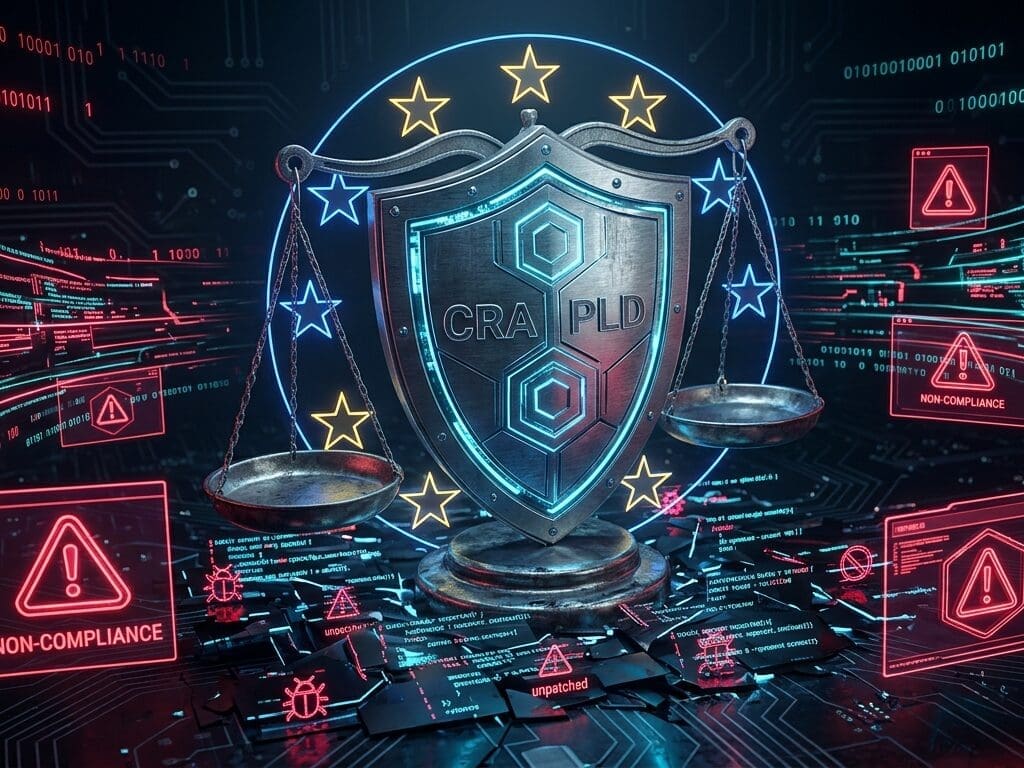
For developers, open-source maintainers, and business owners across Malta and the European Union, the events of Black October are not just technical challenges they carry severe legal consequences under the EU’s evolving digital regulatory framework.
       ┌──────────────────────────────────────────────────────────┐
       │     Software Product or Digital Service in EU Market     │
       └────────────────────────────┬─────────────────────────────┘
                                    │
                  Is the software commercialized or part
                  of a paid product/commercial service?
                                    │
                   ┌────────────────┴────────────────┐
                   ▼                                 ▼
                [ YES ]                           [ NO ]
                   │                                 │
                   │                                 │
     ┌─────────────┴─────────────┐     ┌─────────────┴─────────────┐
     │  Full Regulatory Scope:    │     │ Pure Open Source Scope:   │
     │  • Cyber Resilience Act   │     │ • Non-commercial maintainers│
     │    (CRA Mandatory VHPs)   │     │   generally EXEMPT from   │
     │  • Revised PLD Strict     │     │   CRA manufacturer rules. │
     │    Defect Liability       │     │ • Maintainers still encouraged│
     │                           │     │   to follow security standards│
     └─────────────┬─────────────┘     └───────────────────────────┘
                   │
                   ▼
  Failing to patch known critical flaws (e.g. PHP2Shell)
  constitutes a regulatory violation & actionable product defect.
Is Running an Unpatched System a Cyber Resilience Act (CRA) Violation?
Yes, for commercial offerings.
The EU Cyber Resilience Act (CRA) establishes mandatory cybersecurity requirements for hardware and software products placed on the EU market:
- The Open-Source Exemption: Individuals and non-profit maintainers developing or distributing open-source code outside the course of a commercial activity are generally exempt from CRA obligations.
- The Commercial Scope: The moment open-source software is commercialized whether bundled into a SaaS platform, integrated into enterprise appliances, provided via paid managed hosting, or supported through paid service level agreements (SLAs) it falls directly under the CRA.
- Vulnerability Management Mandates: Under the CRA, commercial manufacturers and distributors are legally required to manage vulnerabilities throughout their product’s lifecycle. Ignoring a known, publicly disclosed CVSS 9+ vulnerability like PHP2Shell or delaying available patches constitutes a direct breach of CRA compliance rules.
Is an Unpatched Flaw a Product Liability Directive (PLD) Issue?
Yes.
The revised Product Liability Directive (PLD) explicitly categorizes software including embedded software, digital services, and standalone applications as a “product.”
- Strict Liability for Software Defects: Under the updated PLD, if a product is deemed “defective” and causes harm (such as data loss, privacy breaches, or system destruction), the provider is strictly liable.
- Failure to Patch as a Defect: If a commercial vendor fails to supply available security updates for known zero-day vulnerabilities (such as PHP2Shell or Cisco SEG flaws), or if an enterprise continues running unsupported end-of-life runtimes without mitigations, the software can be legally classified as defective. If a breach occurs as a result, affected clients or end-users have a direct statutory path to claim damages.
6. Ensuring Compliance: Navigating CRA & PLD with Comply.land
For open-source projects transitioning to commercial models, digital agencies building custom web applications, and enterprise IT teams operating within the EU, balancing rapid software delivery with legal compliance is a significant challenge.
To ensure your software supply chain, vulnerability management protocols, and product architecture comply with EU digital laws, specialized advisory services are essential.

How Comply.land Helps Your Team Stay Compliant:
- CRA Assessment & Readiness: Comply.land assists software teams in mapping Software Bill of Materials (SBOM), establishing compliant Vulnerability Handling Processes (VHP), and structuring update deployment pipelines that align with CRA standards.
- PLD Exposure Auditing: Expert reviews of software licenses, commercial distribution agreements, update SLAs, and liability terms to protect businesses from strict product liability claims.
- Open Source Commercialization Guidance: Clear legal and technical roadmaps helping open-source maintainers and companies commercialize software safely without unknowingly incurring regulatory liabilities.
Final Thoughts for the OSSMalta Community
Black October has shown that software supply chain security requires continuous vigilance. Whether you manage a single WordPress deployment, maintain an open-source library, or build enterprise cloud infrastructure, patching is no longer optional! – It is a legal and operational necessity.
Need help navigating CRA and PLD compliance for your software products? Visit Comply.land for professional regulatory and technical guidance.
Published by the OSSMalta.eu Editorial Team.