

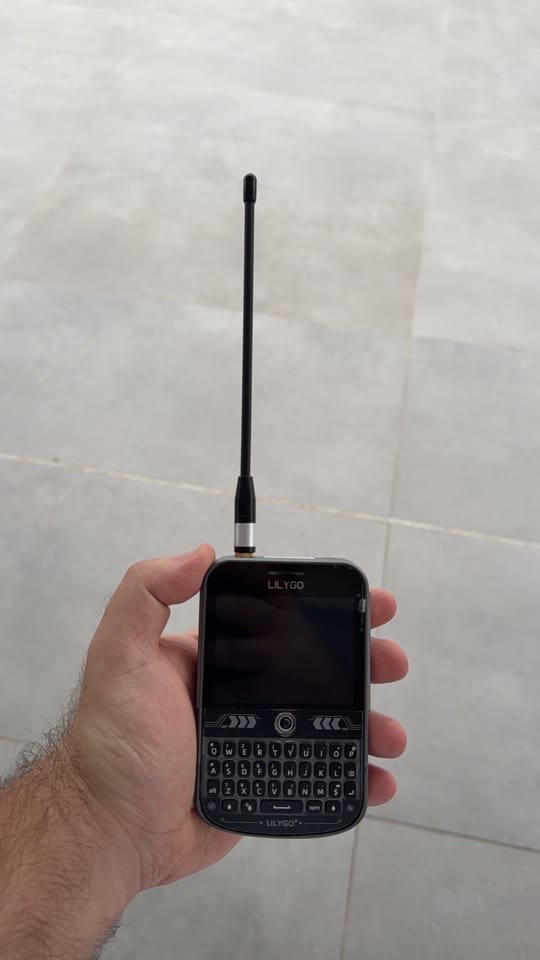
The LILYGO T-Deck Plus, an ambitious all-in-one LoRa device featuring a keyboard, screen, and integrated battery, promised to be the ultimate handheld terminal for the Meshtastic community. We acquired the EU_868 version with an external detachable antenna for field testing in Malta, and while it delivers impressive long-range capability, we found it has a few odd design choices that can make day-to-day use a challenge.
LILYGO T-Deck Plus: Technical Specifications
| Component | Detail |
| MCU | ESP32-S3FN16R8 Dual-core LX7 microprocessor |
| LoRa Transceiver | Semtech SX1262 (supports 433MHz / 868MHz /915MHz options) |
| Transmit Power | Up to +22 dBm |
| Display | 2.8″ inch$ IPS LCD (320 x 240 resolution, touch support) |
| Memory/Storage | 16 MB Flash, 8 MB PSRAM, MicroSD Card Slot |
| Connectivity | 2.4 GHz Wi-Fi, Bluetooth 5 |
| Navigation | Full QWERTY Keyboard, Trackball (also acts as a BOOT button) |
| Location | Integrated GPS Module (e.g., U-Blox MIA-M10Q) |
| Battery | Built-in 2000 Mah (Lithium-ion) |
| Peripherals | Microphone, Speaker, USB-C Port (Power/Programming) |
| Dimensions | 115 x 72 x 20 mm (approx.) |
The Good: Field Performance and Features (Pros)
The T-Deck Plus shines in its primary role as a dedicated, standalone mesh communicator:
- Exceptional Long-Range Capability: The EU_868 frequency model with the external antenna delivered remarkable performance, achieving a link of up to 100 km away to Ragusa, Sicily, on a good day from Malta. This confirms its value as a high-performance relay or personal communication device in optimal conditions.
- Improved Keyboard Experience: Compared to earlier LILYGO devices, the T-Deck Plus features noticeably better keyboard build quality. A major functional improvement is the backlight control: the keyboard backlight can be manually toggled ON or OFF using the key combination ALT + B, a definite pro over previous models.
- Stable Meshtastic Base: Reviewing on Meshtastic Firmware v2.6.11 stable and will soon test on the V2.7.11 Alpha, the device generally offered stable operation, proving its reliability once running.
- All-in-One Form Factor: The integrated QWERTY keyboard and trackball make it a genuinely standalone messaging device, eliminating the need to rely on a smartphone app for basic text transmission.
- Integrated GPS: The dedicated GPS module means it can function as a full-featured tracking node right out of the box, offering location services independent of a connected phone.
The Quirks: Design and Day-to-Day Use (Cons)
The hardware’s design choices present limitations that impact its practicality as an all-day field tool:
- Insufficient Battery Capacity: The $2000\text{ mAh}$ battery is surprisingly small for this type of phone-like device. Most modern handhelds often feature capacities of 5000mAh or more. We are puzzled why LILYGO did not opt for a higher capacity cell, as this moderate-to-small capacity contributes directly to the poor battery life, forcing us to charge the device one to two times a day during active use.
- Suboptimal USB-C Placement: The USB-C port is located on the bottom of the device. Since the external antenna needs to be upright for optimal Line of Sight (LOS) coverage, charging forces the device to lay sideways or flat, which is counterproductive to maintaining a stable radio link. The USB-C port should be on the side to allow for upright charging and use.
- Unnecessary Button Duplication: The device features a physical power switch on the right side and a separate reboot button on the left side of the chassis. The redundant reboot button is questionable, especially since flipping the main power switch to OFF and then ON for a few seconds is a reliable method to clear boot loops.
- Display Quality: The screen is an IPS LCD, not an IPS LED (or OLED). While we appreciate the brightness (set to 45%), the LCD technology gives the display a noticeable white-washed look compared to the superior screen of its sibling, the T-LoRa Pager.
- Stability Issues on Reboot: When recovering from a flat battery or after updating via the Meshtastic USB web client (not the dedicated flasher), the device sometimes enters a boot loop, requiring manual intervention (pressing the physical reboot button or cycling the power switch) to resolve.
- Zero Ruggedness: The device has no IP rating, meaning it is not water or dust resistant. This is a huge drawback for users needing a reliable communication device for harsh environments, such as those operating on a motorbike or at sea, as environmental damage poses a constant risk.
Final Verdict
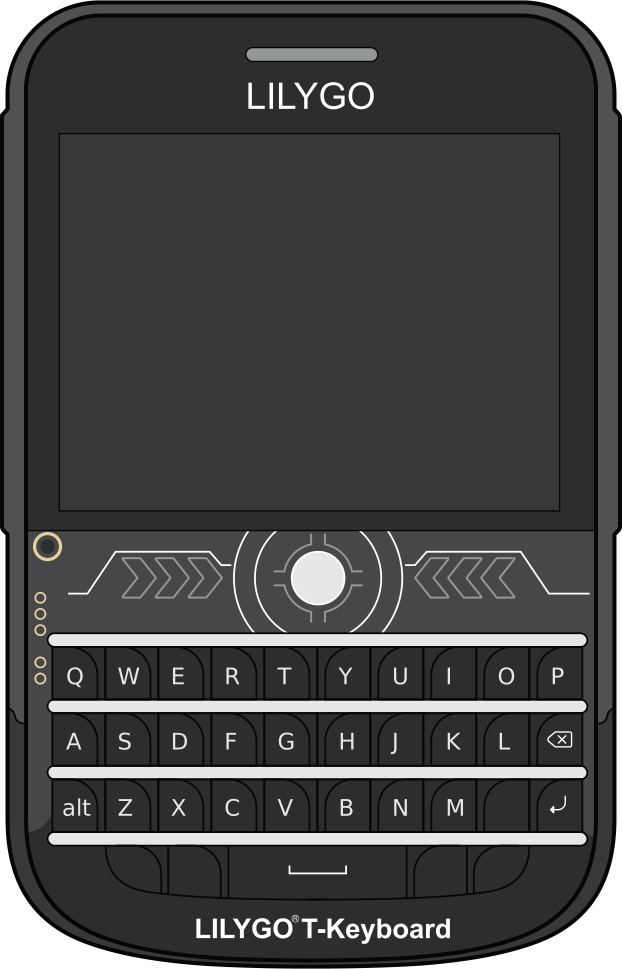
The LILYGO T-Deck Plus is a powerful developer device and a fascinating piece of hardware that demonstrates excellent LoRa performance. It excels as a proof-of-concept for a handheld Meshtastic terminal, offering clear improvements in build quality and usability over its predecessors.
However, its moderate battery capacity, quirky port/button placement, and lack of any ingress protection mean it is not currently suited to be a reliable, all-day, all-weather field communicator. It remains a fantastic tool for enthusiasts willing to work around its design limitations. Its core strength—the potential for extreme long-range links—is compromised by the very elements it needs to overcome for wider use: reliable national coverage (highlighting the need for OSSMalta’s repeater network) and practical, rugged design.